
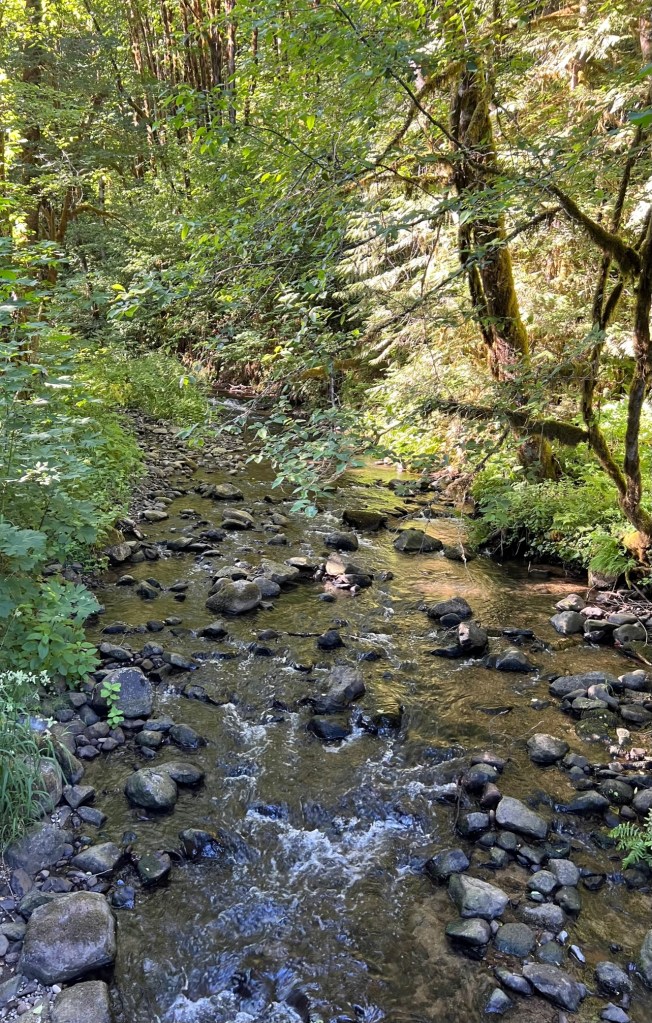
A love rivers and streams. Always have. I’ve fished in many, boated some, and walked for miles along many a riverbank. I scarcely remember my first fishing trip, but Dad has shared the story with me countless times. When I was four, he took me to Dairy Creek to go fishing. It was a small stream near where I grew up and held a lot of family memories. I got lost on that first fishing trip; my dad having left me with my cousins along the bank of the creek as he walked off to his fishing hole. He returned only to find me absent and my cousins not knowing where I’d gone. Frantically, he searched for me, fearing that I’d fallen into the water and drowned. To his glad-hearted relief, some folks from a mile downstream found me and returned me to my dad. My memories of Dairy Creek start there.
The roots of my family lie along that little creek. My uncle Chet owned a homestead near its headwaters at a place called Fern Flat. He had a mill and worked to harvest the old growth timber that filled the property in those days. As a teenager, Dad worked at that mill. He worked hard, sawing logs, hauling lumber and doing whatever else his sister and brother-in-law demanded of him. He’s told me many stories of those days. They had a much-loved pet deer they adopted. To get to school, he’d ride a horse named Ronny four and a half miles to the nearest bus stop. Leaving it at a home in Snooseville, he’d climb aboard a bus that would meander some 27 miles, picking up students as it made its way to Hillsboro High School. They’d pass by a Bureau of Land Management recreation site named Little Bend Park, the old Mountaindale School and store, a turn off to the Restful Haven nudist colony, a lot of old farms, including the farm on which his future wife, my mother, lived. That was his daily routine. And though life wasn’t easy, he has fond memories of those days.
My uncle eventually lost that homestead and all the virgin timber that was still standing. He had failed to pay all the taxes on an employee’s wages. The IRS found out and demanded payment, so the homestead was sold. The farm my mom grew up in was sold off too. My grandma had spent too much time at the tavern, and too much money at the grocery store to feed eight kids. The store demanded payment of the grocery tab, so they lost the farm. Still, in the years to come, dad took me to Dairy Creek to fish on lots of occasions. It was the place where I caught my first trout. As I recall, I shed a tear for that little hatchery trout, having killed a creature for the very first time.
I visited my 92-year-old dad some weeks ago and suggested that we take a trip up memory lane, up Dairy Creek Road, up to the old homestead at Fern Flat. He was eager to go. He gave me directions, describing the journey and landmarks along the way. As one would expect, businesses are gone, houses have changed hands, and landmarks have altered. We made our way up the windy gravel road along the creek until we arrived at Fern Flat. Looking around, to his delight, we found the old, rusted platform on which the big saw for the mill used to sit. Several old logging roads met at an intersection there, but it didn’t take him too long to recognize the way to the old homestead, which lay a mile and a half further beyond a locked gate. We thought for a moment of making the hike to the top of the hill but decided against it. Still, he was entranced. We drove back down the road, trying to find the site of Little Bend Park along Dairy Creek, but any sign of the park was long gone. We made it to the little town of Snooseville, but it didn’t look at all like he remembered it from the 1940s. Further along, the road to the nudist colony was still there, but the signs were gone, as was the colony itself. We passed by the road to Meacham’s Bridge, the place where I caught that first trout. And passed by the farm that was lost to pay the overdue grocery tab.
I was thinking afterwards of all that had changed since my dad worked at that mill so many years ago. My uncle Chet and aunt Bobbie died years ago. The homestead is long gone. All that is left of the sawmill is an old rusting away platform half hidden in the brush. Long gone are the pet deer and the horse named Ronny. Little Bend Park no longer exists. The Mountaindale School and Store closed years ago. And Snooseville has quietly napped away until only a few houses remain.
It all makes me think of a Scripture passage that’s become even more familiar to me as I’ve worked these past couple of years as a hospice chaplain. 2 Corinthians 4:16-5:4 confronts head-on the issues of growing old (4:16), enduring trials (4:17), and death (5:1-5). At one end of the passage, we are encouraged to “not lose heart” (4:16) and at the other end, it speaks of how we “are always of good courage” (5:6). How are we to maintain such a positive hopeful attitude amidst our ongoing challenges?
Amongst the answers is what we find in verse 18, where it says, “as we look not to the things that are seen but to the things that are unseen. For the things that are seen are transient, but the things that are unseen are eternal.” This passage reminds us that there are temporary realities and eternal realities. And whereas the things that we can see are transient, the things that we cannot see are eternal. Instead of focusing on the temporary realities that are a part of our here and now, we are to look to the eternal realities we find in God – in which we find “strength for today, and bright hope for tomorrow” as the great hymn puts it (“Great is Thy Faithfulness,” verse 3).
“How in the world am I to look to the things that are unseen?” you might ask. That seems kind of oxymoronic! But just because you can’t see a thing doesn’t mean it doesn’t exist. Do you believe that you’ve a physical heart that pumps life-sustaining blood through your veins? Have you ever seen it? Jesus is real, though you’ve not seen Him (1 Peter 1:8). Heaven is a real place (2 Corinthians 12:2). So are the riches of the imperishable and unfading inheritance promised to the believer in Christ (1 Peter 1:4). But to see them, you must look through eyes of faith (2 Corinthians 5:7). The believer in Christ has another set of eyes through which he can gaze into these eternal realities. The Apostle Paul’s prayer in Ephesians chapter 1 was that the “eyes of (our) hearts” might be opened to see all that is ours in Jesus—hope for today, riches in heaven, and strength to uphold us on the journey there (Ephesians 1:16-19).
Note that it is the Spirit who works to open the eyes of our heart to these spiritual realities (Ephesians 1:17). His primary mission is to unveil to us and in us and through us the glory of the Lord Jesus (John 16:14). It was He who first opened our blinded eyes to the glory of Jesus (2 Corinthians 4:6). That means we can’t expect to abound in hope if we aren’t careful to walk by the Spirit. And we can’t expect to be much aware of the riches of God’s provision amidst our struggles if we aren’t listening to the Spirit speak to us through the Word. It is impossible to look to the unseen realities that will encourage and strengthen us apart from spending time in the Word.
Helen Keller was only two years old when an illness struck her blind and deaf. Unable to communicate with the outside world, her life was filled with a hopeless despair so great that one can only imagine. Miss Anne Sullivan was brought to assist her and worked patiently to break through the darkness. One day she and “Teacher”—as Helen always called her—went to the outdoor pump. Miss Sullivan started to draw water and put Helen’s hand under the spout. As the cool water gushed over one hand, she spelled into the other hand the word “w-a-t-e-r” first slowly, then rapidly. Suddenly, the signals had meaning in Helen’s mind. She knew that “water” meant the wonderful cool substance flowing over her hand. Quickly, she stopped and touched the earth and demanded its letter name and by nightfall she had learned 30 words. Helen later wrote of the experiences of that day: “As we continued to the house every object which I touched quivered with life. That was because I saw everything with a strange, new sight that had come to me. It would have been difficult to find a happier child than I was as I lay in my crib… and for the first time longed for a new day to come.”
Life isn’t easy. As a hospice chaplain, I’ve said farewell to dozens in the past couple of years. Before that, as a pastor for almost thirty years, many many more. I’ve witnessed a lot of sadness and a lot of tears. God has been so good in it all, but still Laura’s six and a half years of battling cancer has been an arduous journey for us both. How are we to confront such challenges? Understandably, Helen Keller was an angry and out-of-control child before Anne Sullivan came along. She did not know what was happening in her life and what the future held. Anne Sullivan worked so that she could see the unseen realities that made up her world—therein she found hope. Just like that, we’ve a helper in the Holy Spirit who can open the eyes to our heart to the eternal realities that lie ahead at the end of our journey. There’s an abundance of hope in that for those who are growing old and for those who are facing big trials. And for those who are about to pass from this life. We need to be careful to not hold on too tightly to anything in the here and now lest God must one day wrestle it from our grasp. One day, you’ll say goodbye to the temporary realities that encompass this world and all that you now possess. Not so when it comes to Jesus and the eternal realities He has and will provide! Jesus never changes! There will come a day when you will marvel at Him in the glory of heaven. The unseen will be unseen no more! So don’t lose heart, your long journey leads to a house not made with hands, eternal in the heavens (2 Corinthians 5:1). A home that is imperishable and undefiled and unfading, reserved in heaven for you (1 Peter 1:4)! The long and winding road leads home.

 LookingtoJesus