Author: looking2jesus13
TURN YOUR EYES UPON JESUS: The Story Behind the Hymn
Lilias Trotter (1853-1928) grew up in a wealthy London family and could have been a world-famous artist. Her mother recognized her exceptional talent and sent some of her drawings to a world-renowned art critic, John Ruskin. Together with her Mom, Lilias made a trip to Venice and spent some with John. He told her that if she devoted herself to her art “she would be the greatest living painter and do things that would be immortal.” But it was not to be.
Both Lilias and her Mom had responded to the gospel during the London campaign meetings of Dwight L. Moody. Though drawn to the prospect of life as an artist, Lilias decided that she could not do that and continue still to “seek first the kingdom of God and His righteousness.” She became active instead in the YWCA and began a ministry to prostitutes, fearlessly canvassing the streets of London and trying to rescue them from their plight. In 1884, suffering from physical and emotional exhaustion, she underwent surgery. Her heart was permanently damaged in the process.
During the next few years, she began to sense a call to missions and ultimately responded to a plea for workers in North Africa. She applied to the North Africa Mission but was rejected due to her poor health. The mission though ultimately decided—since she had the means to support herself–that she could go and work with others without being an official member.
Nine months later Lilias and two other financially independent women made the trip. Trotter wrote of that experience, “Three of us stood there, looking at our battle-field, none of us fit to pass a doctor for any society, not knowing a soul in the place, or a sentence of Arabic or a clue for beginning work on untouched ground; we only knew we had to come. Truly if God needed weakness, He had it!”
Ultimately she served as a missionary to Algeria for 38 years. The ministry was difficult. Converts were banished and sometimes beaten, some died. Undeterred by poor health and much opposition, her ministry in Algeria eventually grew to include thirty full time workers and fifteen preaching stations.
She did a lot of writing and once wrote a little treatise entitled “Focused: A Story and a Song” which concluded with these words: “Turn full your soul’s vision to Jesus, and look and look at Him, and a strange dimness will come over all that is apart from Him…For “He is worthy” to have all there is to be had in the heart that He has died to win.”
Helen Lemmel (1863-1961) was also born in England, but her family migrated to America when she was 12 years old. Her singing ability soon became evident. She traveled broadly throughout the Midwest during the early 1900s giving concerts in churches. She married a wealthy European and taught voice at the Moody Bible Institute and at BIOLA. She composed over 500 hymns and poems and authored a highly successful book for children. But when she became blind her husband abandoned her.
One day, in 1918, when Helen was aged 55, a missionary friend gave her Lilias Trotter’s tract entitled “Focused.” Her attention focused on this line: “Turn full your soul’s vision to Jesus, and look and look at Him, and a strange dimness will come over all that is apart from Him.” She wrote of what happened next: “Suddenly, as if commanded to stop and listen, I stood still, and singing in my soul and spirit was the chorus of the hymn with not one conscious moment of putting word to word to make rhyme, or note to note to make melody.” So, she wrote the hymn “Turn Your Eyes Upon Jesus” (one of my favorite hymns).
“O soul, are you weary and troubled?
No light in the darkness you see?
There’s light for a look at the Savior,
And life more abundant and free.
Turn your eyes upon Jesus,
Look full in His wonderful face,
And the things of earth will grow strangely dim,
In the light of His glory and grace.”
Those words, “turn your eyes upon Jesus,” speak to the great need and God-given purpose for every soul. Weary and troubled souls can find true solace and lasting hope in the One who died for sins and rose from the dead. In fixing her eyes on Jesus, Lilias Trotter forsook the dream of becoming a world-famous artist to do something of far greater and eternal consequence. Though blind, Helen Lemmel was not prevented from turning her spiritual eyes upon the One who would never forsake her.
“Oh soul, are you weary and troubled?” Who isn’t from time to time? Is there one who can comfort us? Is there one who can capture our hearts and set them aright on a good and prosperous course? Jesus can do all that and more. There is an insightful comment in Lilias’ treatise that caught my attention. She wrote, “It is worthwhile to let God see what He can do with these lives of ours, when ‘to live is Christ.’ How do we bring things to a focus in the world of optics? Not by looking at the things to be dropped, but by looking at the one point that is to be brought out.” In other words, the key to serving Jesus with a “but one thing I do” attitude is not focusing on what we must give up, but by gazing instead on the beauty of the object of our attention (and affection). In this dark and trouble-filled world, may the Spirit work within us that our gaze might be directed to Jesus and the light of HIs glory and grace (Cf. John 16:14). Or, as another hymn puts it: “Thou hast bid me gaze upon Thee, And Thy beauty fills my soul, For by Thy transforming power, Thou hast made me whole” (“Jesus, I Am Resting, Resting;” Text: Jean S. Pigott; Music: James Mountain).
ONLY ONE LIFE – By C. T. Studd
Two little lines I heard one day,
Traveling along life’s busy way;
Bringing conviction to my heart,
And from my mind would not depart;
Only one life, ’twill soon be past,
Only what’s done for Christ will last.
Only one life, yes only one,
Soon will its fleeting hours be done;
Then, in ‘that day’ my Lord to meet,
And stand before His Judgement seat;
Only one life,’twill soon be past,
Only what’s done for Christ will last.
Only one life, the still small voice,
Gently pleads for a better choice
Bidding me selfish aims to leave,
And to God’s holy will to cleave;
Only one life, ’twill soon be past,
Only what’s done for Christ will last.
Only one life, a few brief years,
Each with its burdens, hopes, and fears;
Each with its clays I must fulfill,
living for self or in His will;
Only one life, ’twill soon be past,
Only what’s done for Christ will last.
When this bright world would tempt me sore,
When Satan would a victory score;
When self would seek to have its way,
Then help me Lord with joy to say;
Only one life, ’twill soon be past,
Only what’s done for Christ will last.
Give me Father, a purpose deep,
In joy or sorrow Thy word to keep;
Faithful and true what e’er the strife,
Pleasing Thee in my daily life;
Only one life, ’twill soon be past,
Only what’s done for Christ will last.
Oh let my love with fervor burn,
And from the world now let me turn;
Living for Thee, and Thee alone,
Bringing Thee pleasure on Thy throne;
Only one life, ’twill soon be past,
Only what’s done for Christ will last.
Only one life, yes only one,
Now let me say,”Thy will be done”;
And when at last I’ll hear the call,
I know I’ll say “twas worth it all”;
Only one life,’twill soon be past,
Only what’s done for Christ will last.
UPSIDE DOWN WORLD
Acts 17:6, “These men who have turned the world upside down have come here also.”
The context of this declaration was the visit of Paul and Silas to the city of Thessalonica. The city was about 94 miles from where they had been in Philippi. It was the capital of Macedonia and the most prosperous of its cities. As with other places in the region, the Gentiles of that city were given to idolatry (Cf. 1 Thessalonians 1:9). Because of its central location the city served as a valuable epicenter from which to spread the gospel. Paul would later say of the church there, “For not only has the word of the Lord sounded forth from you in Macedonia and Achaia, but your faith in God has gone forth everywhere” (1 Thessalonians 1:8).
Paul and Silas came to Thessalonica and spent three Sabbath days in a synagogue reasoning with the Jews from the Scriptures, “explaining and proving that it was necessary for the Christ to suffer and to rise from the dead” (Acts 17:3). Some of the Jews were persuaded by his arguments and joined them. A “great many of the devout Greeks and not a few of the leading women” also believed (Acts 17:4). “But the Jews were jealous and taking some wicked men of the rabble, they formed a mob, set the city in an uproar, and attacked the house of Jason, seeking to bring them out to the crowd. And when they could not find them, they dragged Jason and some of the brothers before the city authorities, shouting, ‘These men who have turned the world upside down have come here also’” (Acts 17:5-6).
The men said what they did in a derisive way. It was an accusation meant to trouble Paul and Silas before the civil authorities, but there was truth to it—they had indeed “turned the world upside down.” J. Vernon McGee said of their statement, “Now don’t put that down as an oratorical gesture or hyperbole. When they said that these men were turning the world upside down, that is exactly what they meant. When Christianity penetrated that old Roman Empire, it was a revolution. It had a tremendous effect.”
And, of course, it wasn’t ultimately the men themselves who were doing it, it was the Holy Spirit and the message of the gospel He empowered them to proclaim. It was the Risen Christ who was at work radically transforming the lives of those who placed their faith in Him. The revolution was changing everything. Slaves to sin were being set free. Rebellious idolaters were being transformed into worshippers. By the Spirit, people’s hearts were being filled with hope and love. Jews and Gentiles were harmoniously working together in a common cause. Lives, cities, and regions were being impacted. The revolution would grow to such an extent that the emperor himself would be threatened by it.
The gospel has such an effect on people. And it is a positive thing. The world has been askew ever since Adam’s fall. Created by God, man was made to “glorify God and enjoy Him forever.” But sin has altered man’s gyroscope and he has lost his bearing. Christ died and rose again that He might put things back in order. As A. W. Tozer once said, “Why did Christ come? Why was he conceived? Why was he born? Why was he crucified? Why did he rise again? Why is he now at the right hand of the Father? The answer to all these questions is, ‘in order that he might make worshipers out of rebels; in order that he might restore us again to the place of worship we knew when we were first created.” (A. W. Tozer; “Worship: The Missing Jewel”).
For 2000 years since that gospel has been turning things right side up in the lives of those who trust in Jesus. And through the history of the church, it has done so whenever and wherever it has been proclaimed. The Protestant Reformation worked to put the Word of God and the gospel into the hands of the common people and a spiritual revolution ensued. The gospel preached in the Great Awakening worked to alter the course of history. To this day, in places ‘round the world, upside down people are being reoriented through that same message that Paul and Silas proclaimed so long ago. The world is upside-down, the gospel alone has the power to put things in their proper order (Cf. Romans 1:16-32; 2 Timothy 3:1–17).
RADICAL THINKING
In 1973 a man named Robert Ringer wrote a book entitled “Winning Through Intimidation.” After the manuscript was rejected 23 times by publishers, he decided to self-publish the book. It became a #1 bestseller and spent 36 weeks on the NY Times bestseller list. In 1977 he self-published another book, “Looking Out for Number One.” That book also became a #1 bestseller and is still considered to be one of the top 15 self-help books of all time. That second book was based on the premise that since man’s inherent nature is to look out for number one, we need to do a better job of looking out for number one. Here’s a quote, “We sometimes lose sight of the fact that our primary objective is really to be happy as possible and that all our other objectives, great and small, are only a means to that end.”
That phrase—“looking out for number one”—has since become a part of our culture’s vernacular. But “looking out for number one” is nothing new to any one of us humans. We don’t need a book to tell us to do a better job of it. In sin, selfishness reigns. And since we are all born sinners, we are all born with a natural inclination to put ourselves first.
We are, in sin, self-worshippers at heart. At the beginning of the second chapter of his book, “Improving Your Serve,” Chuck Swindoll writes this: I, ME, MINE, MYSELF. Those four words stood out in bold print. They appeared as if they were forming an enormous monument, each letter seemingly chiseled out in granite. At the base of this strange “monument” were hundreds, perhaps thousands, of people with their arms held up high, as if worshipping at a shrine. And then in very small letters, this caption appeared at the bottom of the editorial cartoon: “Speaking of American cults…”
This, beloved, is the culture in which we live. It is a self-consumed and self-preoccupied society. Worshipping at the idol of self we mistakenly assume that there is virtue and lasting benefit to be gained in the worship of self.
2 Timothy chapter 3 warned of the days in which we live, saying: “But realize this, that in the last days difficult times will come. For men will be lovers of self, lovers of money, boastful, arrogant, revilers, disobedient to parents, ungrateful, unholy, unloving, irreconcilable, malicious gossips, without self-control, brutal, haters of good, treacherous, reckless, conceited, lovers of pleasure rather than lovers of God; holding to a form of godliness, although they have denied its power.” Now we live in these difficult days. And each of the maladies spoken of in this passage are readily recognizable in our society. But note this about the passage, “lovers of self,” comes first. And it would be fair to say that the rest of the maladies follow that first malady. The “Looking Out for Number One” philosophy is, in fact, a recipe for social chaos and disaster. As it has been ever since Adam and Even fell in the garden and sin entered into the world. We read about that in chapter 3, then in chapter 4 we read how Cain, as he was “looking out for number one,” killed his brother.
The long history of humanity is filled with such examples. The reality is that in sin we are selfish and being selfish we don’t relate well to one another. In sin, we are impatient, unkind, envious, prideful, rude, self-seeking, easily angered and embittered.
There is but one example—in the annals of human history—of a man who lived a purely selfless life. And that man is Jesus Christ. Philippians 2:5-8 speaks of Him: “Have this attitude in yourselves which was also in Christ Jesus, who, although He existed in the form of God, did not regard equality with God a thing to be grasped, but emptied Himself, taking the form of a bond servant, and being made in the likeness of men. And being found in appearance of a man, He humbled Himself by becoming obedient to the point of death, even death on a cross.”
What happened when the Word became flesh and dwelt among us? Jesus Christ was the Divine Son of God. He was also a perfect man. He was a man without sin. In Him there was no sin. He never sinned. He was perfectly submitted to the Father in all that He did. And He lived His life according to the godly character that was innate to His person. And so what do we see and find in this God-man, Jesus Christ? He became man and took on the form of a bond-servant. He lived a life of servant-hood. He came into the world with no entourage. He had none of the trappings of royalty. He had no home and no possessions. He came as a servant and He served others. Purposefully. Relentlessly. Sacrificially. And when He had given all that He had but His own life, He gave that up too. And, as I said, His like is unique in the annals of human history. He never exercised a selfish thought. He never did a selfish thing. He never uttered a selfish word. Instead of looking out for number one, the Divine Son of God came into this world looking out for everyone but number one.
Now, by the Spirit, you—believer in Christ—have come to understand something of the beauty of the person of Christ. You’ve worshipped at the shrine of self, but you came to the realization that “self” if a false god that can never work to satisfy your deepest needs and desires. Christ alone can do that. You thought, perhaps, that the universe revolved around you, but you came to realize that it is Christ alone who is worthy of such love and devotion. But you nonetheless live in this flesh and are surrounded by worshippers of self. And that’s why this passage is so important. It reminds us of how God has called us, as believers, to a higher plane of living. A way of thinking and living in Christ that meets with Divine approval. And which proves to be a blessing not only to ourselves but to those around us.
“In the last days difficult times will come, for men will be lovers of self” (1 Timothy 3:1-2). But we need to purpose, by the Spirit, to think differently. Romans 12:2 speaks to the need for us to not be conformed to the world (to not allow the world to press us into its own mold), but to be transformed by the renewing of the mind. This is one of those matters where it is essential that we purpose in Christ to think and live differently.
We are to have the mind of Christ. Note the phrase in verse 5, “have this attitude in yourselves which was also in Christ Jesus.” The Greek term translated “attitude” is the same term translated “mind” in verse 2. It is in the present tense so it speaks of a continuous “mind” or a continuous “way of thinking.” The NASB has translated it attitude and that gives a good sense of it. What’s an attitude? Sometimes we must use that in a negative way. What’s up with your attitude? But one of the definitions of attitude is: “a mental position with regard to a fact or state.” Put simply, it is a way of thinking.
And as we look forward in the passage, to verses 6-8, we can readily identify that attitude in Christ that we are called upon to emulate. It is in respect to His servanthood. To “have this attitude…which was also in Christ Jesus” is to think about your life in relationship to others as that of being a servant.
Note the other phrase used to represent the mindset we are to maintain as believers: “with humility of mind” (2:3). The term translates a combination of terms, one meaning “low-lying” and the other “mind.” The idea is lowliness of mind. It is set against the other term in the verse, conceit.
God calls us as believers to this mind-set, one of lowliness of mind. Now humility is commonly disdained and likewise commonly misunderstood. It’s good for us to have a good, Biblical definition of what is meant by the term. Romans 12:3 is helpful, “For through the grace of God given to me I say to every man among you not to think more highly of himself than he ought to think; but to think so as to have sound judgment, as god has allotted to each a measure of faith.” Humility involves having a proper estimation of ourselves.
C. J. Mahaney uses this definition: “Humility is honestly assessing ourselves in light of God’s holiness and our sinfulness.” In sin we are prideful and ignorant of these truths. But the Holy Spirit does a wonderful work in opening our eyes to the glory of God and His holiness and simultaneously convicting us of the depth of our sin problem. Humility is essential not only in our relationship with God, but it also impacts the way we relate to others. How important is humility in how we relate to God? The Scripture repeats this principle of truth three times: “God is opposed to the proud, but gives grace to the humble.” And when it comes to our relationships with others, pride is at the source of all kinds of strife and divisions. That is why Peter says, “clothe yourselves with humility toward one another” (1 Peter 5:5).
There is a great quote regarding humility from Andrew Murray. He said, “Humility is perfect quietness of heart. It is to expect nothing, to wonder at nothing that is done to me, to feeling nothing done against me. It is to be at rest when nobody praises me, and when I am blamed and despised…The humble person is not one who thinks meanly of himself, he simply does not think of himself at all.”
We have a great example of this attitude of Christ provided for us in the gospel of Mark (Mark 10:35-45). James and John went to Jesus to ask of Him that he might give to them the privileged seats, on His right and His left, when He came into power. Now they didn’t understand some things. They believed Jesus to be the Messiah. But they couldn’t understand what He was saying when He spoke to them of His pending suffering and death. They were all headed to Jerusalem, and then Jesus would be made to be king. So they asked for those privileged positions of power. And Jesus responded by again speaking of His pending suffering and the sufferings that they themselves would eventually face. Now after this discussion ensued, the rest of the disciples “began to feel indignant with James and John” (Mark 10:41). This is not the only occasion when we read of such a thing. Later in Jesus’ ministry, after He shared the last supper with His disciples, a discussion ensued amongst the disciples as to which one of them was the greatest. So these disciples were far from perfect men, they were prone to the same “looking out for number one” way of thinking that has infected us all. But Jesus responded to the matter by distinguishing between two different ways of thinking and living. He said that the Gentiles function according to man’s way of thinking. Rulers “lord it over them.” People vie for the highest positions and when they get them they use their power to command others and demand certain things from them. And, according to man’s way of thinking, this is perfectly acceptable and normal behavior. We might even speak of it according to what is commonly called “upward mobility.” But Jesus said that that’s now how things work in God’s economy, “But it is no so among you, but whoever wishes to become great among you shall be your servant; and whoever wishes to be first among you shall be slave of all. For even the Son of Man did not come to be served, but to serve, and to give His life a ransom for many” (Mark 10:44-45). In God’s economy greatness is not defined in terms of “upward mobility,” but “downward mobility.” Greatness in God’s kingdom looks like servanthood and Christ Jesus Himself is the great testimony to that truth.
In his book, “True Humility,” C. J. Mahaney differentiates between greatness as defined by the world and by God: “The difference couldn’t be more stark. As sinfully and culturally defined, pursuing greatness looks like this: Individuals motivated by self-interest, self-indulgence, and a false sense of self-sufficiency pursue selfish ambition for the purpose of self-glorification. Contrast this with the pursuit of true greatness as biblically defined: Serving others for the glory of God.”
Note that phrase there, “The Son of Man did not come to be served, but to serve.” Philippians 2:5 is telling us that we are to think the same way as Jesus. And we ought to be able to say the same thing about ourselves.
• In our marriage: I am not in this marriage to be served, but to serve.
• In our family: I am not in this family, to be served, but to serve.
• In our relationships at work or at school: I am not here to be served, but to serve.
• In our church: I am not here to be served, but to serve.
We would say: “I am glad to serve you in Jesus’ name. My great goal and aspiration is to know and love and serve the Lord Jesus Christ, and these things I do by following His example.”
With respect to the radical way of thinking God calls us to, the hymn, “May the Mind of Christ, my Savior,” puts it well. And it is a prayer. That the Holy Spirit may work through the Word of God, so that in our walk with Christ we might have the attitude of Christ: “May the mind of Christ my Savior, live in me from day to day, By His love and power controlling, all I do and say.”
We are likewise called to a radically different way of relating to others. “Do nothing from selfishness” it says. The term translated “selfishness” denotes “ambition, self-seeking, rivalry.” Vine’s Expository Dictionary explains that “self-will” is the underlying idea in the word. So it is that in us that is self-centered and demanding and contributes to a spirit of divisiveness.
The cause of this self-seeking behavior is an overestimate of one’s own importance. “Empty conceit” and selfish behavior go hand in hand. And, as we’ve already stated, there are a host of miserable consequence that go along with this kind of behavior.
We’ve got a couple of great examples in Scripture of both the positive and negative to what is expressed here in verse 3. In 3 John we read of Diotrephes. It is said of him that he “loved to be first among them.” Apparently Diotrephes had a problem with pride. This was a man who called himself a Christian. But his behavior was hardly Christ-like. He denied the authority of the Apostle John. John was an apostle appointed by the Lord Jesus Himself. He had walked with Jesus and had witness Jesus’ death and resurrection. He had faithfully served Jesus for decades. He had suffered much in bearing witness of the Lord Jesus, but in his prideful arrogance, Diotrephes showed no respect to that wonderful man of God. And then there was the matter of showing Christian hospitality. When other associates of John would go there to visit, Diotrephes wouldn’t receive them. And if that wasn’t bad enough, if anyone dared to receive these friends of John, Diotrephes would put them out of the church. Diotrephes was not living his life according to the truths of this verse. He was of the “looking out for number one” mindset.
Look at Philippians 2:19-21. Here we find another man, Timothy—Paul’s beloved son in the faith. Paul was hoping to send Timothy to the church in Philippi so that he could receive a report on how things were going. He said that he had no one else of “kindred spirit who (would) be genuinely be concerned for (their) welfare” (2:20). Timothy was of kindred spirit with Paul, but they both were of kindred spirit to the Lord Himself. They had that “attitude which is in Christ Jesus.” Note what Paul went on to say. “For they all seek after their own interests, not those of Christ Jesus” (2:21). Timothy is a wonderful example of this Philippians 2:3 way of living. Now I know of nothing that will work to promote unity better in a marriage or home or church than for each member to adopt this approach to relating to others. If every member will seek after the interests of Christ Jesus, they will prove him or herself to be a source of great blessing to others. Philippians 2:3 is a verse to memorize and meditate on and allow it to become deeply rooted in your heart. That the Spirit might work to transform you through this Word.
“Do not merely look out for your own personal interests, but also for the interests of others” (Philippians 2:4).
I’m reminded of the story of Uncle Bob’s Shoes. It was on one of my first trips to Uganda. Pastor Bob and I had been leading a conference for pastors in Kabaale Village. We were walking back to the guest house for lunch. Bob stopped along the way to talk to one of the pastors. When he was approaching our dining area, I noticed that he was walking gingerly along the path. I looked then at his feet and noticed that he was wearing some crude and well-worn sandals. “What happened to your shoes,” I asked? He explained to me how the pastor had stopped him and asked him to pray that God would provide him with some shoes because his sandals were hurting his feet. So, Bob had taken off his shoes and gave them to this pastor in exchange for the man’s sandals. And as we were talking, Bob removed those pain-inflicting sandals. And we were both amazed at what we saw. The pastor had tried to repair the sandals, holding them together by punching a bunch of tacks through the soles. And though he had tried to stub the points on the upward side, they still poked through and caused some discomfort when you tried to walk in them. Why would Pastor Bob give away his sandals? Because he was living according to his mindset. He was living out what it says, “Do not merely look out for your own personal interests, but also for the interests of others.” He had another pair of shoes. He was glad to serve Jesus by serving this pastor and looking out for his interests.
History tells us of how a man named Copernicus studied the sky and came to a startling conclusion regarding the order of things. He said, “If man is to know the truth, he must change his thinking! Despite what we have said for years, our earth is not the center of the cosmos—but just one celestial body among many. The sun does not move around us; we move around the sun.” Years later someone did a study on children and concluded, “Each child must have his or her own “Copernicus revelation.” Indeed, we are all in need of such a thing.
Beloved, God has called you to walk in Jesus’ footsteps. There is no virtue or valor in selfishness. What does courage and strength and a purposeful life look like? It looks like Jesus. And God calls on all of us to follow in His steps. To adopt, by the Spirit, His way of thinking and to replicate, again by the Spirit, His way of living. And make no mistake about it—this radical way of thinking and living—is impossible for any of us in our own flesh. It will do us no good to try harder to be better when it comes to these matters. We can only do any of this as we are led and empowered by the Spirit to do them. But let’s pray that it would be so. Unto the glory of our Savior.
The BEST Best Friend
Jesus is the best friend any of us can ever have
No one can love like Jesus
No one can forgive like He does
No one else can save us
No one else has the power to change us from the inside out
He knows all about us, but loves us still
He knows all about the challenges we face—He faced them too—and cares
Other friends aren’t perfect, He is perfect in His person and in all His ways
He is wise beyond measure
The greatness of His love was made evident in His willing sacrifice for sin
The strength of the surpassing greatness of His power was revealed in His resurrection from the dead
Other friends may fail us, He never will
Other friends may desert us, but He will never leave us or forsake us
Though He may not give us all we want, He knows what’s best for us and Will always give us what we need
In Him we can find true peace
In Him we can possess a true and lasting joy
In Him we have a certain hope, even when all other hopes prove futile
He is a friend to all who will but trust in Him—-no matter age or gender or color or standing in this world
The richest amongst us is nevertheless poor if He doesn’t have Jesus for a friend
The poorest amongst us is nevertheless rich beyond measure if He has Him
When we breathe our final breath it’s a friendship with Him that will bring us safely home to heaven
And we’ll marvel at Him when we see Him face to face
IT’s BETTER
It’s better to give, than to get
It’s better to forgive, than to forsake
It’s better to build up, than to tear down
It’s better to encourage, than to discourage
It’s better to speak kind words, than to repeat hurtful ones
In a world filled with troubles, it’s better to ease burdens than to add to them
It’s better not to blame others, but to take personal responsibility for one’s own actions
It’s better not to blame your own troubles on your circumstances, but to strive to learn from them and persevere
It’s better to forget your past failures, than to use them for an excuse to fail
It’s better to be a peace maker, than a peace breaker
It’s better to leave a place better off than you found it, rather than to mess it up
It’s better to be a good friend. To expend yourself in loving others. To demand or expect nothing in return. To want the best for others and to be glad when others succeed in their doings.
It’s better to believe that God can make a way, than to cheer for hopelessness
It’s better, far better, to love than to hate
HOW GOD CALLED US TO LCBC
My first visit to Lewis and Clark Bible Church was on June 3rd, 1973. My next visit would come 17 years—almost to the day—later, on June 1st, 1990. I have in my office the LCBC Guest Book that bears my signature from way back then. Along with my signature, I gave my address and listed my home church as being “St. Matthews, Hillsboro.” In reality, it had been a long time since I’d set foot in St. Matthews Catholic Church, but that was the only church I’d ever been in and I didn’t have anything else to put in the box.
I was a lost 17 year old, without God and without hope in the world. I hardly remember a thing from that long ago visit. I’m not even sure why I had come, though I imagine it was because my Uncle Bob—who I had always looked up to— had invited me. Uncle Bob had been saved through the ministry of LCBC back in the early 70s. Some teens from the church had gone out doing visitation, speaking to people about Jesus and inviting them to church. They were taken aback by what they found when Bob invited them in. He was contrary and difficult. They went back to the church and asked people to pray for this wild fellow. He soon visited the church and received—contrary to what he had expected–a warm welcome. Later, he responded to the gospel, becoming the first member of my extended family to be saved. And he was eager to pass on what he himself had experienced.
Thinking back to that 1973 visit, I would have never imagined that God would call me to pastor any church, let alone this one. If anyone would have suggested such a thing, I would have thought them to be crazy. But God does indeed work in mysterious ways His wondrous deeds to perform!
A year and a half after that visit, I joined the Navy. It was partly out of frustration that I did. I didn’t have the money or wherewithal to go to college. Not knowing what else to do with my life, I signed up for the Navy’s Nuclear Power Program. After a couple of years of schooling, I found myself serving in the submarine service and stationed in Pearl Harbor. By that time, other members of my extended family had come to know the Savior. And they were praying for me. And I was growing increasingly concerned about my sins. I believed in God, but didn’t know anything about Him. I didn’t know who Jesus was or that He had died for my sins. I had never read the Bible and didn’t know the difference between the Old Testament and the New. But people were praying for me. And the Spirit was working in my heart. I knew that something needed to change, but I didn’t know what or how. I had done a lot of stupid, sinful things, and couldn’t imagine how God could possibly save or forgive me. I visited some churches. I remember visiting a Baptist church in Honolulu. I can even remember an instance when a man in that church tried to share the gospel with me. But at that point, I was not understanding and was not responding. Some fellow sailors started attending a church in Kailua. They had met some girls there and I suppose that was a part of the reason that I went with them. I heard the gospel preached there, but it was not until a member of the Navigators spoke to me personally that I trusted in Jesus.
After my discharge from the service, I got a job with Portland General Electric at the Trojan Nuclear Plant. It was a year later that God brought Laura into my life in answer to my prayers. We were married in August of 1983. Soon afterwards, I landed a job in the Training Department. It was a good salary job that paid very well. We bought a house in Columbia City. We were attending St. Helens Community Bible Church in St. Helens where I was serving as an elder. Our firstborn, Claire, was born in 1985. I had a good job, a nice home, a great church, and a wonderful family. I should have been happy. But I was becoming increasingly dissatisfied in my job, feeling as if I wasn’t doing what I was supposed to be doing. Try as I might, I couldn’t get away from that. I talked to Laura about it. I talked to my co-worker friend Jeff about it. I mulled it over in my mind and prayed much about it. And at last, I (we) made the decision to resign from my job to attend Western Seminary in Portland. My co-workers thought I was nuts (unbeknownst to them or me at the time, Trojan was destined to close down a few years later). With PGE’s help, I had received a bachelor’s degree in Nuclear Technology, so I could enroll at Western to get my Master’s. I also had Veteran’s benefits that would help out with my educational expenses. I resigned, but PGE offered to keep me on part time in my salary position. God was gracious in abundantly providing for all of our needs. So I went to school.
In the last year of my seminary education, Laura and I applied to Northwest Independent Church Extension. Once accepted, I would be made available to churches that were looking for a pastor. It was in April of 1990 that we invited Roy Sprague, the Director of NICE, to dinner at our house. He spent quite some time talking about the various churches around the northwest and in Nevada that had need of a pastor. Then he asked me something to the effect of where I sensed God might be calling me to serve. I remember saying to him, “something on the Oregon coast; something like Lewis and Clark Bible Church.” Of course, I didn’t mean Lewis and Clark Bible Church itself (as far as I knew they had a pastor), but for whatever reason, God had put that thought of serving on the coast in my heart.
In the next month or so, there were some potential pastor placement opportunities, but none of them quite fit. And then one day, we returned home to find a message on the answering machine. The message was, in fact, two messages because the caller couldn’t fit everything into the first call. In a thick Norwegian accent, the caller, Vic Albertsen, was saying that he and a man named Jim Thompson had called Roy Sprague asking for help because they needed someone to fill the pulpit. Roy had given them my name as someone who might be willing to come. I found out later that they had considered closing the church, but had decided instead to pray, asking God to intervene in their needy situation. I called Vic back and told him that I would be glad to help. It was arranged that we would come on June 1st, 1990. Not quite seventeen years after my first visit.
Jim would henceforth often speak of those days. He would remind the church of how he and Vic had set their hearts to pray and how God answered their prayers by sending me. He would tell that story to the church, sometimes with tears in his eyes, to encourage them. I always felt a little embarrassed when Jim did that, but appreciated his perspective. He was a man who believed that God could restore the church. He trusted God and prayed. He was faithful to pray for the church. He prayed for new families to come. He prayed for God’s provision of additional leaders. In those early days, it was sometimes only Jim, Vic, and me at prayer meeting. But those two faithful men kept on trusting, serving, and praying.
The previous ten years had been none too kind to LCBC. Four pastors had served the church during that decade. A preceding 50-50 church split had worked to soil the church’s reputation in the community. The building project that had started 20 years before still was not finished. The church yards were unkempt. The parsonage was in a bad state of disrepair. The departure of another pastor was accompanied by sadness and despair. More families had left. There were about a dozen in attendance on that June 1stSunday. Our first month’s giving would amount to about $600. There were a host of reasons to be pessimistic. But we arrived that June 1st Sunday. I preached a way-too-fast sermon from Colossians chapter one on the supremacy of Christ. When we left that day, I had no doubt whatsoever in my mind that God was calling me here. And the marvel of it all has never escaped my thoughts—God brought me to pastor the church that had been used by Him in the salvation of the first member of my extended family!
Soon after my first filling-the-pulpit Sunday, a pastor from Astoria called. He wanted to meet with me. Not knowing his exact purpose, I nonetheless agreed to travel from Columbia City to have lunch with him at the Logger Restaurant in Knappa. The purpose of the meeting soon became apparent. He wanted to warn me of what I was getting myself into. He told me that LCBC had a reputation of devouring pastors and I should think twice about involving myself and my family in such a situation. I thanked him for his concern but countered that if God was calling me to pastor the church, then He would take care of us in whatever manner He deemed best. I didn’t subsequently give much thought about that pastor’s warning, until one day when I asked one of our leaders what was under the big mound of dirt in the front yard of the church. Jokingly, he told me that was where all the ex-pastors were buried. Sometime later, we excavated that mound of dirt and found some pieces of an old sidewalk.
Helen Leigh, a founding member of the church, invited me over to lunch one day. It was Helen and her good friend Harriet who first came up with the idea of converting the old Seppa Dairy seed barn into a church. They were delightful older ladies and I have fond memories of them both. Helen played the organ. Harriet played the piano. Harriet would continue playing the piano until she was no longer physically able (she served in that role for 50 years!). I didn’t realize it at the time but Helen had an ulterior motive behind her invitation. Though she wasn’t the decision-maker, she wanted to interview me. I can recall but one of her many questions. She asked me what I thought was the most important virtue for a pastor to possess. I answered, humility. She thought integrity. We agreed that both are important. From that point forward, Helen accepted me in, and I was blessed to count her a friend.
We accepted the call to pastor the church in an August 1st installation service. Ethel Gustafson, a wheel-chair bound, long-time respected and loved member of our church (now home with Jesus), wrote a letter to the church for that service exhorting her fellow members to exercise care in their treatment of their new pastor. Her letter was later published in the Voice Magazine (the monthly publication of IFCA International). This is what she wrote: “We have a challenge to overcome how we are regarded by those in the area: bad attitudes; we’re a church that gobbles up pastors. We can change if we: examine our own hearts; resolve differences as soon as possible; do not quibble over trivial matters; work together as a team with pastor, deacons, trustees, and others; remember our pastor is human (he’ll make mistakes, get tired, and be overworked); remember no good pastor is good at everything; remember he has physical needs, financial problems, family needs just like we do; remember he needs a living wage; remember he needs time to be left alone for devotions and Bible study and prayer; remember his children are no better or worse than ours; remember his wife has as many needs as any wife and can’t be expected to be at every meeting much less be in charge of all of them; remember he is a special target of Satan and needs our daily prayers; remember each of us needs to be available to do something and make it known we are. Remember to get things into perspective and ask ourselves, ‘Why do we exist?’: to improve our own spiritual lives; to worship together; to be a corporate witness of Lewis and Clark Bible Church to the area (one bad apple will spoil the whole box); we are a support group each for all and all for each.”
That first year of ministry was difficult. I met every week with Harriet Pollard, the treasurer, to figure out how we could pay the bills. I kept my part time job at Trojan and commuted once a week to supplement our finances. Eventually, I quit that job and took a job at Clatsop Community College teaching beginning algebra. But since we were living in the parsonage, we didn’t need much. After a year or so, I was able to give up part-time work.
I have fond memories of those early days. There were a lot of obstacles. Many doubted that the church could recover. But God worked to restore unity and make a church family out of our small group. We have a friendship quilt that was given to us by the church on our one year anniversary. Each family in the church made their own quilt square. Each square is beautiful in its own way, but put together, the beauty of the whole mosaic is greater than that of any individual part. The body of Christ is kind of like that. Its beauty lies in its glorious Lord and Savior who indwells and unites them all. And we can trust the One “who is able to do far more abundantly than all that we ask or think” to do a good work in His church and in our lives (Cf. Ephesians 3:20). It is a glorious work that He is doing.
My part? I came, because God sent me here. I stayed, because God kept me here. I’m still here because God hasn’t sent me anywhere else. So much has happened in 25 years! And though some from those early days are still with us, many are now with Jesus. I did more than my share of funeral services back then! I sometimes say that ministry includes the good, the bad, and the ugly. We’ve experienced all of these things—both wonderful blessings that rejoice the heart and heart-rending trials that lead to despair. But praise God for His faithfulness! He has done a great work in us and made us to be, in Christ, a people apt to love and serve! We can count on Him to finish the work that He started in us and to supply the grace for the work that He calls us to (Cf. Philippians
They Told Him About Her
Mark 1:29-31, “And immediately he left the synagogue and entered the house of Simon and Andrew, with James and John. Now Simon’s mother-in-law lay ill with a fever, and immediately they told him about her. And he came and took her by the hand and lifted her up, and the fever left her, and she began to serve them.”
The true identity of Jesus was made evident from the beginning of His earthly ministry through the miracles He performed. With divine power and authority, He cast our demons and healed the sick. These miracles testified to the truth that He is “the Christ, the Son of God (Cf. John 20:31). We read of one such miracle in our passage.
He left the synagogue and proceeded to the house of Simon’s mother-in-law, accompanied by four of His newly-called disciples. The location of the house where they lived is known, and those who visit Israel often visit the site of it. It is a large home with multiple rooms and kitchens, which says something about the family’s situation in the city of Capernaum. They were likely of above average wealth and influence.
Showing hospitality was especially important in that culture. We read in Luke’s gospel about Mary’s concern in preparing for Jesus’ visit to their home. And even today, mothers will go to great lengths in cleaning and meal preparation to make a home ready for guests. One can imagine the distress of Simon’s mother-in-law inasmuch as guests had arrived, but she was incapacitated by an illness.
The illness must have been quite serious. She was bedridden. She had a fever sourced in some kind of serious malady. There was, of course, no recourse, in that day, for folks like her. The body would either heal itself or the person would die. Those folks were akin to the people I’ve visited in Africa, most lacking the ability to go to a doctor.
So, there she lay, grieving her sickness though she’d rather be greeting her guests. And suffering though she’d rather be serving. And there she lay, without any hope of help, feeling sick, weak, and incapacitated.
But Jesus had come to visit, and His visit changed everything. The text says that “they told him about her” (Mark 1:30) and they did so “immediately.” It was their first and most important concern in entering the house. Put simply, they took their matter of concern to Jesus. That’s a good formula when it comes to dealing with our problems. In fact, we are exhorted to do that very thing (Cf. 1 Peter 5:7).
In this case they took their concern regarding someone else to Jesus. As most of you probably know, my wife, Laura, has stage IV metastatic breast cancer. We are well past the two-year mark in her struggle. Combined with that, her spine has been damaged from top to bottom. And if that wasn’t enough, she suffers daily from something called post-herpetic neuralgia. Over these difficult months, lots of folks in lots of places have prayed for her, and uniquely so in my recent visit to Africa. We were at a marriage conference in a place called Bukomansimbi. My uncle, Pastor Bob Emrich, and myself had done some teaching. We invited the folks to submit written questions for us to answer after lunch. Then we proceeded to deal with the questions, one by one, until we got to the very last one, as it was nearing the end of the conference. I had spoken earlier in the day of Laura’s condition, so perhaps that is what prompted the question which concerned what a spouse is supposed to do if his or her partner is suffering from a chronic illness. My partners both looked at me, indicating that I should be the one to answer that one. So, I spoke for some time, citing some Scriptures and speaking of the need to follow in the example of Jesus. And to remain faithful and to serve and to do one’s best in giving care and attending to needs, etc.
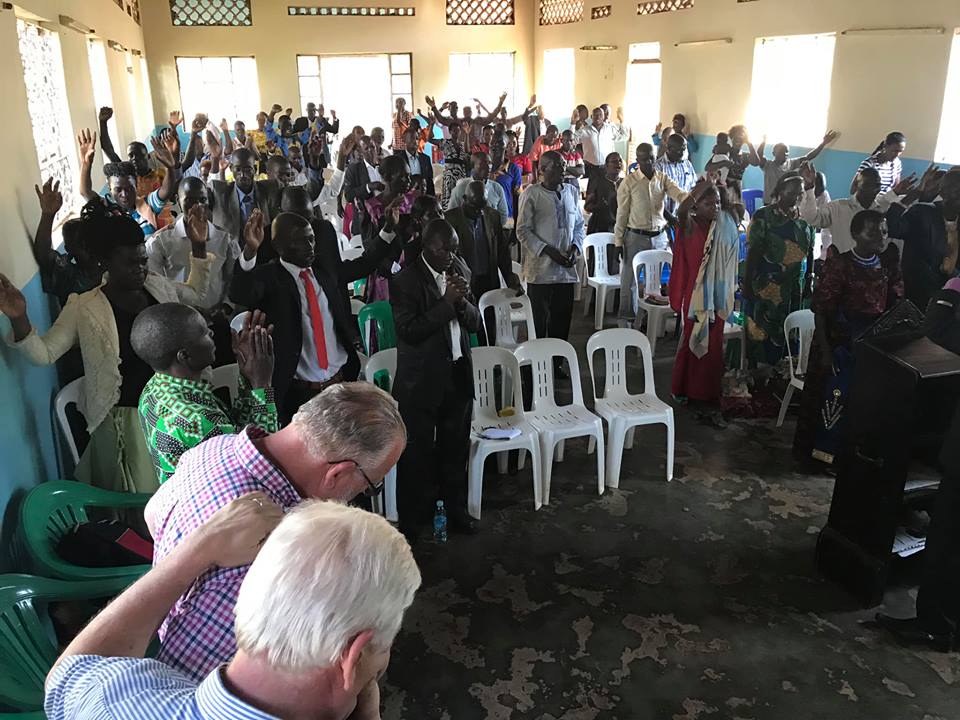
No sooner had a sat down, then the pastor’s wife of the hosting church stood up. She asked those in attendance, about 125 or so, to stand and pray for Laura. So, they gladly and immediately stood and lifted their hands to the sky, as they do, and began to pray in unison—everyone was praying. Their prayers were in Lugandan so I couldn’t understand what was being said, but the fervor in which they prayed was obvious. When the time came, as if on some mysterious cue, the praying stopped, and they all sat down.
It is a humbling thing to be prayed for like that. Those impoverished brothers and sisters all have their own set of needs and problems, but they’ve got hearts full of faith and tender concern, so when given the opportunity to care, they didn’t hesitate. They did the same thing that those early disciples did— “they told him about her!”
Now there’s a difference between what happened with Simon’s mother-in-law and what has happened thus far with Laura. Jesus took Simon’s mother-in-law by the hand and lifted her up and the fever left her. So far Laura’s experienced no healing☹ But lest we think that their prayers—or anyone else’s prayers—haven’t mattered we need to address a few things.
People have ongoingly and repeatedly “told him about her,” when it comes to Laura’s condition. So, what has He done? How has He responded? To be sure its been hard, hardest for her, but by God’s grace we’ve been well provided for. Laura’s got a wonderful team of doctors who are both well-qualified and compassionate. In unforeseen ways, He has provided all the necessary insurance/funds to pay for all her medical costs (likely now approaching $1,000,000.00). Laura’s condition is not much improved, but her attitude has been amazing. She trusts in Jesus. She reads her Bible. She prays. She doesn’t pity herself in her condition. She finds ways to serve others. She forgives as she always has.
There’s a deeper healing that matters more than just the physical. When we are sick, we want nothing more than to be made well. We’ll go to great lengths, and even spend huge sums of money, to fix our body problems. But even if a person is in perfect physical health, they can still be spiritually sick. And the spiritual sickness is of greater concern than the physical. We are all born sinners (Romans 3:23; 5:12). Jesus alone can free us from the penalty, practice, and ultimately the very presence of sin (1 Corinthians 6:11; Philippians 3:21). He can heal our souls.
Laura’s propensity to smile, as she does, and serve others, as she’s always been prone to do, testifies to the fact that Jesus has indeed heard the prayers of many on her behalf. She’d prefer, of course, that God would heal her body too, as would we all, but God has His own purposes in all that He allows and we can only trust Him, for “we know that for those who love God all things work together for good” (Romans 8:28). As it is, God has, by grace, well-provisioned her with a good measure of hope and peace and joy amidst her afflictions. She’s got a strong testimony!
Having been healed, Simon’s mother-in-law, promptly responded to her heart-felt desire to serve her guests. She was set free to do that which was best. Jesus is good at doing that. We need to take our cares to Him. He cares and He’s able to do something about them.
BACK TO UGANDA 2019
Click on the following to access the report: