MAY 19

A Barrier Busting Prayer

Bible Reading: Acts 10

We were living in Columbia City, Oregon in the spring of 1990.  I was finishing up my Bible training at Western Conservative Baptist Seminary.  Having sensed a call to pastoral ministry, Laura and I were praying and waiting on the Lord to show where He would send us.  In that same time frame, unbeknownst to us, two men in Astoria, Jim Thompson and Vic Albertson, were praying for a pastor for their church.  Their church had met with troubles, they’d thought of closing the doors, but decided instead to pray God would somehow provide a pastor.  God worked through their prayers and ours to bring us together.  Astonishingly God called me to serve as pastor of the same church where the very first member of my extended family was saved!  Until he departed to be with Jesus, Jim Thompson (an elder in our church and dear friend and a man who was devoted to prayer), would frequently thank God in his prayers for having answered his prayer in sending us.  And, of course, we ended up serving there for twenty-seven and ½ years.  Isn’t it amazing how God is well pleased to work through the prayers of men to accomplish His plan!  We have a fitting example of that in this Acts, chapter eight.

Approximately seven years had passed since Jesus’ commission to the Apostles to be His witnesses “to the ends of the earth” (Acts 1:8).  It took a “great persecution” to scatter believers to the “regions of Judea and Samaria” (Acts 8:1).  Even then there was no real attempt to take the message to the Gentiles.  The gospel outreach to the remotest part of the earth was apparently of remote concern (except for Philip’s outreach efforts; Acts 8:40).

The problem was, there were longstanding religious traditions and prejudices which stood in the way. It was unlawful for a Jew “to associate with or visit anyone of another nation” (Acts 10:28) or to eat with them (Acts 11:3). In NT times the Jews had little regard for the Gentiles. So strong was their animosity that a common Jewish prayer went something like this, “God thank you that I was not born a woman or a Gentile.” There were Jewish laws which prohibited contact with Gentiles. If a Gentile was invited into a Jewish home, he was not to be left unattended, lest every article of food and drink be henceforth regarded as unclean. The animosity by the Jews towards the Gentiles (and vice versa) was pervasive. It impacted every aspect of life. It was possible for a Gentile to be proselytized to Judaism, but it rarely happened. Gentile converts were rarely treated fairly and were commonly looked on with suspicion.

God would have to intervene if the gospel were to be taken to the Gentiles. And that’s exactly what He did in bringing Cornelius and Peter together. Cornelius was “a devout man who feared God, with all his household, gave alms generously to the people and prayed continuously to God” (Acts 10:2). God, having heard his prayers, gave him instructions to send for Peter (Acts 10:4). Peter was about thirty-five miles away in Joppa. The next day, as Cornelius’ men were on their way, Peter went up on the housetop to pray. Through repeated visions God revealed His will to Peter regarding what would soon happen. While Peter was perplexed by the meaning of it all, the men sent by Cornelius arrived and spoke to Peter. He went away with them to Caesarea. Peter and Cornelius then met and explained to each other how God had worked to bring them together.

Peter shared the gospel with Cornelius and his household (Acts 10:34-43).  “While Peter was still saying these things, the Holy Spirit fell upon all who heard the word” (Acts 10:44).  The seed of the gospel message fell on the fruitful soil of well-prepared hearts!  What a wonderful day!  The circumcised believers who had accompanied Peter were “amazed” (Acts 10:45).  In an instant God tore down centuries-old and firmly established barriers.  God worked in an amazing way through the prayers of those two men, to break down an insurmountable barrier that had been centuries in the making.  Friends, we’ve no idea how God will work through our prayers to accomplish a certain thing, but we know that He can.  And so, we remain devoted to prayer.  Just like Cornelius.

“Thou Art Coming to a King, Large Petitions with Thee Bring” – John Newton

COME, MY SOUL, THY SUIT PREPARE (John Newton)

Come, my soul, thy suit prepare,
Jesus loves to answer pray’r.
He Himself has bid thee pray,
rise and ask without delay.

Thou art coming to a King,
large petitions with thee bring,
for his grace and pow’r are such,
none can ever ask too much.

With my burden I begin,
Lord, remove this load of sin!
Let Thy blood, for sinners spilt,
set my conscience free from guilt.

Lord! I come to Thee for rest,
take possession of my breast;
there Thy blood-bought right maintain,
and without a rival reign.

While I am a pilgrim here,
let Thy love my spirit cheer;
as my Guide, my Guard, my Friend,
lead me to my journey’s end.

Show me what I have to do;
ev’ry hour my strength renew;
let me live a life of faith;
let me die Thy people’s death.

MAY 18

Praying for Our Enemies

Bible Reading: Acts 7:54-60; Matthew 5:44-48

“Love your enemies and pray for those who persecute you” (Matthew 5:44).

Seemingly, we all know that special someone in our life who likes to cause us trouble.  Whether it be a co-worker, classmate, family member, or a neighbor, at some point in our lives we will interact with somebody who opposes our faith and seeks to do us harm, going out of their way to make things difficult.  I’ve experienced such things both in the workplace and in ministry.  How do we deal with such folks?  In the world’s way of thinking the best way to respond to ill treatment is to respond in kind, yet God calls us to love even our enemies and to pray for them.  

When it comes to praying for our enemies, Stephen provides for us a great and inspiring example.  Stephen was a man who was full of the Spirit (Acts 6:3).  Being filled with the Spirit, he was also full of “wisdom,” “faith,” and “grace and power” (Acts 6:3, 5, 8).  By the Spirit he was doing “great wonders and signs among the people” (Acts 6:8).  He was a man much used by God!

Stephen stood out amongst the brethren and was no doubt deeply loved by them (Acts 6:5), yet there were others who did not like him at all.  A group of Hellenistic Jews “rose up and disputed with Stephen.”  “But they could not withstand the wisdom and the Spirit with which he was speaking” (Acts 6:10).  So, they instigated others to make scandalous reports about him.  They stirred up “the people and the elders and the scribes” (Acts 6:12).  They “seized him and brought him before the council” (Acts 6:12).  False witnesses were brought forth and accused him.  The high priest asked, “Are these things so” (Acts 7:1)?  Most of the rest of chapter seven is Stephen’s response, in which he recounted Israel’s past and applied its historical apostasy directly to his listeners.

With Spirit-imparted boldness, he indicated they were responsible for the death “of the Righteous One” (Acts 7:52).  At that point in Stephen’s defense his audience became “enraged and they ground their teeth at him” (Acts 7:54).  He was privileged, by the Spirit, to be granted a vision of “the glory of God, and Jesus standing at the right hand of God” (Acts 7:55-56).  His report of what he saw only intensified their anger.  In a state of rage they screamed, covered their ears, and mobbed him (Acts 7:57).  They dragged him out of the city and stoned him (Acts 7:58).  As they were stoning Stephen, he called out, “Lord Jesus, receive my spirit” (Acts 7:59).  As he was dying, he spoke to the One who had died to forgive his own sins, saying, “Lord, do not hold this sin against them” (Acts 7:60). 

They killed the messenger, but not the message.  Saul was there and “approved of his execution” (Acts 8:1).  Yet Saul, that great persecutor of the church, would later be saved and befriend Stephen’s Savior.  On the day of Stephen’s death there arose “a great persecution against the church in Jerusalem.  As a result, they were all scattered throughout the regions of Judea and Samaria” (Acts 8:1).  The church was scattered, but those “who were scattered went about preaching the word” (Acts 8:4).  That great persecution, initiated through Stephen’s martyrdom, only worked to expand the outreach of the church.   They silenced Stephen, but not the Spirit.  And Stephen’s legacy—as a bold faithful witness to the truth—lives on to this day.

Jesus prayed for God’s forgiveness for those who crucified Him.  Stephen likewise prayed for those who stoned him.  They both prayed amidst their suffering, and not for themselves but for the ones who were causing their harm.  How much more shall we then pray for those who trouble us, that God might work to overcome evil with good (Romans 12:14-21).  Put that difficult-to-get-along-with person on your prayer list and pray for them, and then wait to see what God might do!

“Do Not be Overcome by Evil but Overcome Evil with Good” (Romans 12:21).

RESCUE THE PERISHING

Rescue the perishing,
Care for the dying,
Snatch them in pity from sin and the grave;
Weep o’er the erring one, lift up the fallen,
Tell them of Jesus the mighty to save.

Refrain:
Rescue the perishing,
Care for the dying;
Jesus is merciful,
Jesus will save.

Though they are slighting Him,
Still He is waiting,
Waiting the penitent child to receive;
Plead with them earnestly, plead with them gently;
He will forgive if they only believe. [Refrain]

Down in the human heart,
Crushed by the tempter,
Feelings lie buried that grace can restore;
Touched by a loving heart, wakened by kindness,
Chords that were broken will vibrate once more. [Refrain]

Rescue the perishing,
Duty demands it;
Strength for thy labor the Lord will provide;
Back to the narrow way patiently win them;
Tell the poor wanderer a Savior has died. [Refrain]

MAY 17

Prayer Amidst Opposition

Bible Reading: Acts 4:1-31

“They lifted their voices to God with one accord” (Acts 4:24, NASB)

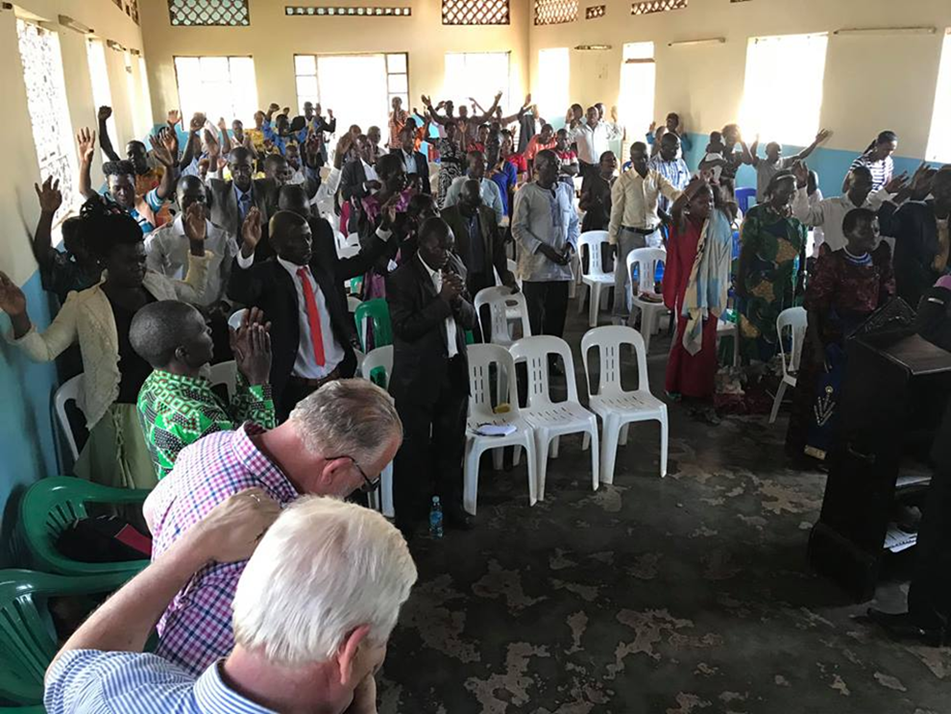
It was about five years ago…Inspired and challenged by the example of our Ugandan brethren, God led me to organize something we went on to call “Pray for Clatsop County.”  I met with a fellow pastor and outlined a plan by which we could seek to gather believers from like-minded churches to pray.  Our plan was to focus on our churches, our families and our outreach to the lost in our community.  It was not a simple thing, because we knew how difficult it would be to get believers from different churches to agree to do anything!  Kind of like herding cats!  But we prayed fervently and garnered prayer support from our two churches.  I began to call on pastors in the community.  Some of them recognized the need and were very excited about it.  We arranged for a date and a meeting place at Astoria High School.  I had no idea how many would come.  In the end we were pleasantly surprised and encouraged.  Ten different pastors and over one hundred believers gathered together to pray.  Pastors led in prayer.  Then we broke into small groups to pray over specific needs.  That was the first of three such gatherings!  There was a need for believers to gather together, devoting themselves to prayer and things haven’t changed.

As I organized those prayer meetings, one of the passages in the back of my mind was the prayer of the early church found in Acts chapter 4.  There we find a model prayer for the church in the challenges we face.  In that account, In the name of Jesus, Peter healed a 40-year-old beggar who had been lame from birth (Acts 3:1-8).  The people at the temple witnessed the event and were filled with “wonder and amazement at what had happened to him” (Acts 3:10).  That led to a second opportunity for Peter to proclaim the truth about Jesus (Acts 3:11-26).  The religious leaders were greatly annoyed with Peter and John for “proclaiming in Jesus the resurrection from the dead.  And they arrested them” (Acts 4:1-2).  “But many of those who had heard the word believed and the number of the men came to about five thousand” (Acts 4:4).  

The powerful Sanhedrin set Peter and John in their midst and interrogated them about what they had done.  Peter and John did not shrink back from declaring the truth.  Instead, they clearly stated salvation could be found in no One else, except Jesus (Acts 4:12).  This baffled the religious leaders.  They didn’t know what to do because an undeniable miracle had taken place.  In fact, as the religious leaders were interrogating Peter and John, the man who had been miraculously healed stood beside them.  In the end they decided to charge Peter and John “to speak no more to anyone in this name” (Acts 4:17-18).  Peter and John could not possibly obey, for they had received a command from Jesus Himself to be His witnesses (Acts 1:8, 4:19-20).  So, after threatening them some more, the religious leaders decided to let Peter and John go.

So, what did Peter and John do?  What didn’t they do?  They didn’t wring their hands in distress.  They didn’t organize a protest against the religious leaders (not that it would have done any good).  We find no evidence of their grumbling or complaining over their circumstances.  What did they do?  They returned to their friends and told them what had happened and together they took the matter to God in prayer.  Here we find the church’s first major obstacle.  For the first time they faced intense visible opposition and the threat of persecution.  So, they prayed!  There’s a lesson here for us. Those early believers marked out a path for us to follow.  When troubles come our way the best thing we can do is pray!

And what did they pray?  Maybe not as we might expect.  They prayed to their Sovereign Lord, the One who created all things (Acts 4:24).  The religious leaders were powerful, but they served a God who was and is omnipresent, for Whom nothing is impossible.  These early believers understood their lives were in His hands. They prayed Scripture, reminding themselves their experience was not mere happenstance. The events had been prophesied centuries beforehand in the Scriptures (Acts 4:25-26).  They reminded themselves of the sovereignty of God over their circumstances.  They realized God had likewise previously worked through evil men to accomplish His purpose (Acts 4:27-28).  Their prayer request?  That they’d be given further opportunities to proclaim the truth about Jesus and that they would do so with all boldness (Acts 4:29-30; 1:8).  God was so pleased with their prayer; He shook the place where they were gathered (Acts 4:31)!  Then He emboldened them in their witness just as they had prayed (Acts 4:33)!

We live in needy times.  Our hearts must remember our God is the creator of all, for Whom nothing is too difficult.  Nothing currently happening in our world is contrary to what we’ve been previously warned about in the Scriptures.  God is no less sovereign over the affairs of men than He was when those folks prayed as they did.  Right now, in these difficult times, we have good news to share!  People need the Lord!  “Lord, look upon their threats and grant to your servants to continue to speak your word with all boldness” (Acts 4:29).  Amen.

When Troubles Come Our Way the Best Thing We Can Do is Pray!

GOD OF GRACE AND GOD OF GLORY

God of grace and God of glory,
on your people pour your pow’r;
crown your ancient Church’s story,
bring its bud to glorious flow’r.
Grant us wisdom, grant us courage
for the facing of this hour,
for the facing of this hour.

Lo, the hosts of evil round us
scorn the Christ, assail his ways.
From the fears that long have bound us
free our hearts to faith and praise.
Grant us wisdom, grant us courage
for the living of these days,
for the living of these days.

Cure your children’s warring madness;
bend our pride to your control;
shame our wanton, selfish gladness,
rich in things and poor in soul.
Grant us wisdom, grant us courage
lest we miss your kingdom’s goal,
lest we miss your kingdom’s goal.

Save us from weak resignation
to the evils we deplore;
let the gift of your salvation
be our glory evermore.
Grant us wisdom, grant us courage
serving you whom we adore,
serving you whom we adore.

MAY 16

Devotion to Prayer

Bible Reading: Acts 2:42

“And they were continually devoting themselves to the apostle’s teaching and to fellowship, to the breaking of bread and to prayer” (Acts 2:42, NASB).

My uncle, Pastor Bob, and I were in Uganda leading a two-day marriage conference in a place called Bukomansimbi.  On the afternoon of the second day, we answered questions the pastors and spouses had previously submitted to us.  The folks there were aware of Laura’s condition, and how she’d been suffering with chronic pain and other disabilities associated with her cancer.  It was not surprising then, when someone asked me how a spouse can best care for their partner if he or she is struggling with a chronic illness.  That was to be the last question and conclusion of the conference, but when I sat down after responding, the pastor’s wife of the hosting church stood up.  She asked those in attendance to pray for Laura.  Immediately the group collectively stood to their feet and with many lifting their hands to heaven, they began to pray.  All that was being said had been spoken in Lugandan, but our leader and interpreter explained to us what they were doing—they were praying for Laura!  

They prayed with an obvious fervor; the sound of their voices interwoven in a glorious chorus of prayer for my wife. Then, as if on some mysterious unspoken cue, they all stopped praying and sat down.  It’s a humbling thing to be prayed over in that fashion.  Our impoverished brethren, in that faraway place, have plenty of needs and problems of their own.  Yet they have hearts full of faith and tender compassion, so when given an opportunity to pray, they don’t hesitate.  Over the course of my many visits to Uganda I was both inspired and convicted by their example in their devotion to prayer.  I imagine it must have been something akin to what was happening in the early church.

In Acts 2:41 we read of the miraculous conversion of three thousand souls and then in the very next verse we read about what they were doing.  There are four things mentioned, the church has been engaged in these four practices ever since.

How did they know to do these things?  It was the Spirit who caused them to be born again.  It was the Spirit who instructed and led them.  These are not just four good “things” for believers in Jesus to do, they are all intimately associated with our relationship with Jesus.  It is the Spirit of God who mediates to us the presence of Jesus.   It is the Spirit who leads us in the practice of these four disciplines.  Those early disciples were continually devoting themselves to the apostle’s teaching.  Why?  Because they loved Jesus and wanted to hear from Him.  They were doing the same with respect to prayer.  Why?  Because they loved and worshiped the Lord.  They needed Him and wanted to communicate with Him.  The same goes for fellowship.  They wanted to be with His people.  And in the breaking of bread.  They knew it was important for them to remember what Jesus had done for them.

They did these things out of love and devotion to their Savior.  And so, it is the same when a person comes to faith in Christ.  They are Spirit-led to pray, give attention to the Word, seek fellowship with other like-minded believers and gladly are reminded of His love in the breaking of bread.  You no doubt had the same experience.  You were born again to a love for Jesus which revealed itself in a love for His Word, His People, His Remembrance and a love to talk to Him in Prayer. 

At the heart of these four “Spirit-led” disciplines then, is a Spirit-borne love for Jesus.  As such, these practices serve as a barometer of sorts when it comes to what’s going on in our heart.  Prayer is right there in the mix.  How’s my prayer life?  Why don’t I want to talk to Jesus as I should, or once did?  Why has being at church become a mere obligation instead of a joyful thing to be embraced?  Has sin gotten in the way?  Has my love for Him grown cold?  What can work to make a change, not just that I might pray as I should, but that my walk with Jesus should be all God intended for it to be?  No matter the problem, prayer is the best response to any need.  Be honest with God about where you’re at.  As we’ve seen in all the various examples, we’ve looked at this month, God is faithful to answer our prayers!

Lord, please work in our hearts, restoring in us that vibrant devotion to prayer which was both evident in the early church and in us when we first came to know You!

We Love to Converse with Those We Love.  At the Heart of Devotion to Prayer is the Desire to Converse with Our Savior whom we Love and has So Loved Us

SWEET HOUR OF PRAYER

Sweet hour of prayer! sweet hour of prayer!
that calls me from a world of care,
and bids me at my Father’s throne
make all my wants and wishes known.
In seasons of distress and grief,
my soul has often found relief,
and oft escaped the tempter’s snare
by thy return, sweet hour of prayer!

Sweet hour of prayer! sweet hour of prayer!
the joys I feel, the bliss I share
of those whose anxious spirits burn
with strong desires for thy return!
With such I hasten to the place
where God my Savior shows his face,
and gladly take my station there,
and wait for thee, sweet hour of prayer!

Sweet hour of prayer! sweet hour of prayer!
thy wings shall my petition bear
to him whose truth and faithfulness
engage the waiting soul to bless.
And since he bids me seek his face,
believe his word, and trust his grace,
I’ll cast on him my every care,
and wait for thee, sweet hour of prayer!

MAY 15

Jesus’ High Priestly Prayer

Bible Reading: John 17

In his devotional study on the Gospel of John, John G. Mitchell shares these thoughts regarding Jesus’ magnificent prayer, “Now He brings us right within the holiest of all, and we are permitted to sit down in the presence of God.  We are allowed to sit there and witness this fellowship, this communion, this bond, this oneness, this equality between the Father and the Son.  How much do we really know about coming within the veil of the holiest of all, and being perfectly at home in the presence of the Father and the Son?”  From the depths of the very heart of Jesus, this prayer invites us to listen in to the loftiest of all prayers.  We are herein privileged to hear of God’s plan for the ages, whereby His glory is unveiled to all through His redemptive work.

So, what do we find Jesus praying about?  Note the prayer is divided into three parts.  In the first five verses Jesus prays for Himself.  Then in verses 6 through 19 Jesus prays for the apostles who were with Him.  In the remaining verses of the chapter, He prays for all His people throughout history.  There is a common theme running through the entire chapter.  In verse one, He prays, “glorify your Son that the Son may glorify You.”  In verse 10 He prays regarding His apostles, “I am glorified in them.”  And again, in verse 22 He prays over every believer throughout time, “The glory You have given me I have given to them.” 

Jesus came not just to save sinners, but that He might be glorified in them.  I love this quote by A.W. Tozer: “Why did Christ come? Why was He conceived? Why was He born? Why was He crucified? Why did He rise again? Why is He now at the right hand of the Father? The answer to all these questions is, in order that He might make worshipers out of rebels; in order that He might restore us again to the place of worship we knew when we were first created.”  In His prayer Jesus prayed regarding this restoration. All that He has done is unto His glory.  And so, we should pray that He might be glorified in our lives.

It would be impossible to plumb the depths, or explore the vast reaches of this transcendent prayer, but there are several things we can focus on, things which instruct us in what we should pray about: 1) He prayed we would know Him.  In fact, eternal life equates to knowing “the only true God, and Jesus Christ whom (He) has sent.”  Nothing matters more than this.  So, we pray to know Him better and for others to know Him, too.  2) He prayed we would grow in Him.  Our sanctification is a recurrent theme in this prayer (John 17:16-19).  As God’s children we are out of place in this world, having been set apart for Him.  We’ve been called to holiness and more than anything else it is the truth of the Word that works to transform us.  So, we pray to love the truth and walk in it.  It is also through the pursuit of the truth that we preserve the unity He has established in His body and experience the “oneness” for which He prayed.  3) He prayed we would share the truth with others (John 17:18).  And so, as we share the Gospel, we pray for ourselves, that others will come to know Him. 4) He prayed we would be where He is in order “to see (His) glory” (John 17:24).  That’s our destiny, and our hearts yearn for the day when we shall be with Him.  Our prayers should likewise be governed by this heavenward focus in the desire to see Him as He is (1 John 3:2).

There is another main thought to be understood through Jesus’ prayer for us.  John MacArthur commented on this: “He gives us the most magnificent example of our need for prayer. If the Son of God who controls all things, who is the ruler over all things, who is sovereign over all things, if the Son of God who knows all things, who has all power depends upon God to fulfill all His words, how much more are we dependent on God?”

What Mattered to Jesus in His Praying Should Matter to Us in Ours

TO GOD BE THE GLORY

To God be the glory, great things he has done!
So loved he the world that he gave us his Son,
who yielded his life an atonement for sin,
and opened the life-gate that all may go in.

Refrain:
Praise the Lord! Praise the Lord,
Let the earth hear his voice!
Praise the Lord! Praise the Lord!
Let the people rejoice!

Great things he has taught us, great things he has done,
and great our rejoicing through Jesus the Son,
but purer and higher and greater will be
our joy and our wonder, when Jesus we see. [Refrain]

MAY 14

Thy Will Be Done

Bible Reading: Matthew 26:36-46

Walking on my way to work this morning I noticed a sign hanging on the front of a neighbor’s house which said, “God accepts knee mail.”  Kind of a funny play on words, but it speaks of an important truth, we serve a God who has repeatedly invited and encouraged us to pray to Him.  We believers are incredibly blessed because Jesus has worked to avail access for us to the very throne of grace, whereby we can go with confidence “to receive mercy and find grace to help in time of need” (Hebrews 4:16).  Which begs the question, why do we struggle so when it comes to devotion to prayer?  We are not alone in our struggle, as you may have noted in today’s Bible reading, for while Jesus was agonizing in prayer, His disciples were sleeping. 

Just as Jesus is the best example to us in all that is good and virtuous, so He is the best example for us when it comes to devotion to prayer.  It was his regular practice, as “he would withdraw to desolate places and pray” (Luke 5:16; Mark 1:35).  He prayed during His baptism and as He fasted for forty days in the wilderness (Luke 3:21, 4:1-2).  He prayed all night before choosing His twelve disciples (Luke 6:12).  When He took Peter and John and James to the mountain, where He would be glorious transfigured before them, it was so that they could pray (Luke 9:28).  He prayed as He shared in the bread and cup that spoke of His pending death and sacrifice for sins (Matthew 26:26-29).  And, of course, He repeatedly prayed from the cross (Matthew 27:46; Luke 23:24, 46).  He prayed to the Father in His “high priestly prayer” (John 17) and again in the Garden of Gethsemane as the time of His death drew near (Matthew 26:36-46). 

Jesus knew the purpose for which He had come, He had known it all along, for it was the Father’s will that He should die for the sins of man.  So, He repeatedly instructed His disciples, though they could never understand.  Now, as the cross looms large, and His hour has come, we find Him agonizing in prayer in the Garden of Gethsemane.  As He contemplates the cup He’s soon to drink, His soul is “sorrowful, even to death” (Matthew 26:38), and his “sweat became like great drops of blood falling down to the ground” (Luke 22:44).  There are transcendent aspects of His struggle which we are to human to comprehend, but we know this—He who was perfectly sinless, and who existed always in perfect harmony with the Father, was soon to be made sin (2 Corinthians 5:21) and bear the full measure of the Father’s wrath (Matthew 27:46).  And so, He prayed.  He agonized in prayer.  He prayed three times.  In prayer, He prepared Himself to meet the biggest spiritual trial that would ever be faced by anyone (Hebrews 5:7).

Jesus had previously warned His disciples of what would soon happen. They would all fall away (Matthew 26:31). Peter’s response? “I will never fall away…even if I must die with you, I will not deny you” (Matthew 26:33-35). “All the disciples said the same” (Matthew 26:35). Give them credit for their intentions, but good intentions are never enough when it comes to resisting the spiritual temptations we face. Jesus led them to the garden and exhorted them, saying, “Pray that you might not enter into temptation” (Luke 22:40, 46). But just as Jesus prayed three times, he stepped aside after each to check on His disciples and each time found them dozing. They needed to “watch and pray,” but instead “he found them sleeping, for their eyes were heavy” (Matthew 26:43). We know the rest of that story. Jesus was arrested, and the disciples fled. Peter found himself in the courtyard of the high priest, where three times he denied Jesus. Temptation came their way and having failed to pray they failed in that which they had promised and purposed to do. And so it goes for us.

How beautiful this example of Jesus!  How glad we should be for His triumph over sin and death on the cross!  His example of devotion to prayer is one we need to look to.  He was always devoted to prayer and agonized in prayer when the going got tough.  Do you know what?  If Jesus needed to pray, how much more do we!  And then, on the other hand, we have the bad example of the disciples to avoid.  No, we can’t do the thing by simply trying harder to do better or giving it our best shot.  The battles we face in the spiritual realm are too big for us.  “The spirit indeed is willing, but the flesh is weak” (Matthew 26:41).  Apart from Jesus we can’t do a thing.  And so, we pray, and look to “the One who in every respect was tempted as we are, yet without sin” drawing near to “the throne of grace” since He, our High Priest, has worked to avail access for us (Hebrews 4:14-16).

If Jesus Himself Needed to Pray, How Much More Do We!

IN THE HOUR OF TRIAL

In the hour of trial,
Jesus, plead for me
lest by base denial
I unworthy be.
When you see me waver,
with a look recall,
nor for fear or favor
ever let me fall.

With forbidden pleasures
should this vain world charm
or its tempting treasures
spread to work me harm,
bring to my remembrance
sad Gethsemane
or, in darker semblance,
cross-crowned Calvary.

Should your mercy send me
sorrow, toil, and woe,
or should pain attend me
on my path below,
grant that I may never
fail your cross to view;
grant that I may ever
cast my care on you.

When my life is ending,
though in grief or pain,
when my body changes
back to dust again,
on your truth relying,
through that mortal strife,
Jesus, take me, dying,
to eternal life.

MAY 13

The Lord’s Prayer

Bible Reading: Matthew 6:5-15

This familiar prayer is commonly referred to as the “Lord’s Prayer,” but Jesus never actually prayed it Himself, for He had no need to pray “forgive us our debts.”  Instead, inasmuch as He taught His disciples to pray in this manner, it is better known to us as “The Disciple’s Prayer.”  In contrast to the mindless repetition that typifies many prayers (Matthew 6:7), this prayer serves as guide or model as to the manner in which we are to pray.

We should note that the initial focus in the prayer is upward, the first three requests having to do with matters pertaining to God’s glory.  The remaining three requests are for our own well-being.  God first, ourselves second; His glory before our wants and needs.  Such was the pattern in the Old Testament prayers we’ve examined. And is the model laid out for us here.

We have previously noted that prayer is an act of worship, whereby we acknowledge the “worth-ship” of God—note how this prayer starts there.  We have also seen how prayer expresses our trust in and dependence on God.  That is also at the heart of this prayer.  Note too, the expressed need for forgiveness, which has been a component of many of the prayers we’ve observed.  This prayer reminds us again how we need to be careful to avoid a “laundry list” approach to praying focused on just our immediate needs.  From the start the prayer emphasizes our relationship to our Father who is in heaven, and its our relationship to Him that matters most.

There is much for us to think on here in this glorious prayer, but that great preacher Charles Spurgeon well summarized some important thoughts.  So, here’s what he had to say in one of his “Morning and Evening” devotionals:

“This prayer begins where all true prayer must commence, with the spirit of adoption, ‘Our Father.’ There is no acceptable prayer until we can say, ‘I will arise, and go unto my Father.’ This child-like spirit soon perceives the grandeur of the Father ‘in heaven,’ and ascends to devout adoration, ‘Hallowed be Thy name.’ The child lisping, ‘Abba, Father,’ grows into the cherub crying, ‘Holy, Holy, Holy.’

There is but a step from rapturous worship to the glowing missionary spirit, which is a sure outgrowth of filial love and reverent adoration—’Thy kingdom come, Thy will be done on earth as it is in heaven.’

Next follows the heartfelt expression of dependence upon God—’Give us this day our daily bread.’

Being further illuminated by the Spirit, he discovers that he is not only dependent, but sinful, hence he entreats for mercy, ‘Forgive us our debts as we forgive our debtors:’ and being pardoned, having the righteousness of Christ imputed, and knowing his acceptance with God, he humbly supplicates for holy perseverance, ‘Lead us not into temptation.’

The man who is really forgiven, is anxious not to offend again; the possession of justification leads to an anxious desire for sanctification.

‘Forgive us our debts,’ that is justification; ‘Lead us not into temptation, but deliver us from evil,’ that is sanctification in its negative and positive forms.

As the result of all this, there follows a triumphant ascription of praise, ‘Thine is the kingdom, the power, and the glory, for ever and ever, Amen.’

We rejoice that our King reigns in providence and shall reign in grace, from the river even to the ends of the earth, and of His dominion there shall be no end. Thus, from a sense of adoption, up to fellowship with our reigning Lord, this short model of prayer conducts the soul.”

“Lord, teach us to pray.” – Luke 11:1

CHILDREN OF THE HEAVENLY FATHER

Children of the heav’nly Father
safely in his bosom gather;
nestling bird nor star in heaven
such a refuge e’er was given.

God his own doth tend and nourish;
in his holy courts they flourish.
From all evil things he spares them;
in his mighty arms he bears them.

Neither life nor death shall ever
from the Lord his children sever;
unto them his grace he showeth,
and their sorrows all he knoweth.

Though he giveth or he taketh,
God his children ne’er forsaketh;
his the loving purpose solely
to preserve them pure and holy.

MAY 12

A Desperate Plea for Help

Bible Reading: Jonah 1-2

I had a “Jonah-like” experience once.  I was hundreds of feet underwater, in a very smelly place, praying about a need I had.  The difference was that I was praying from the belly of a submarine, not a whale, and the smelly place was the berthing area, not the inners of a fish, and my prayer need was not nearly as desperate as Jonah’s.  But then again, it was while serving on board the submarine that I came to the realization that Jesus could work to save someone like me—so maybe it wasn’t so different after all.

The trouble was of Jonah’s own making.  God commanded Jonah to go and preach to Nineveh, a fearsome empire that would in a future day conquer the northern Kingdom of Israel.  But instead of obeying, Jonah went the opposite way, and headed south to Joppa.  Obviously, he wasn’t happy with his God-given task, so he attempted to flee his omnipresent God (Psalm 139:7-12).

“The Lord hurled a great wind upon the sea” (Jonah 1:4).  The mariners on board were afraid and each cried out to his god.  They cast lots to determine whose fault it was that such evil had come upon them and, of course, the lot fell on Jonah.  Under interrogation Jonah admitted that he was fleeing from the presence of the Lord.  After trying their best to row the boat to dry land, it was decided that there was no other choice but to toss Jonah into the sea, at which point the sea ceased from its raging.

Just as the Lord caused the wind, and stopped the sea from raging, He appointed a great fish to swallow up Jonah.  “And Jonah was in the belly of the fish three days and nights” (Jonah 1:17).  And for those who assume that the story about Jonah is nothing but a big fish story, it should be noted that Jesus Himself referred to Jonah’s experience as a factual event (Matthew 12:40).

It should be noted at this point that the fish was for Jonah both a source of trouble and a temporary means of salvation.  For it’d have been even more hopeless (at least from a human standpoint) if Jonah had been thrown into the sea without any vessel to carry him.  But in his whale of a predicament, God had gotten Jonah’s attention.  That fleeing from the presence of God wasn’t such a great idea after all!  It never is.

Jonah didn’t have a lot of options at this point.  Even if he’d have had a cell phone, there’d have been no service.  And no Coast Guard to rely upon.  He knew enough to realize that there was no hope to be had in idols (Jonah 2:8).  So, Jonah prayed.  From the belly of a whale, he prayed.  Perhaps you’ve prayed in desperation before.  In recent months I’ve witnessed more than a few death bed prayers.  God hears such prayers.

Two main themes are interwoven throughout Jonah’s prayer, Jonah’s distress and God’s deliverance.  Eleven different Old Testament scriptures are alluded to in Jonah’s prayer.  Jonah’s situation was beyond hopeless, yet God heard Jonah’s prayer and answered him (Jonah 2:1).  It was when Jonah said, “Salvation belongs to the Lord” that “the Lord spoke to the fish, and it vomited Jonah out upon the dry land” (Jonah 2:9-10).  God answered Jonah’s prayer.  After that disastrous detour, the Lord again commanded Jonah to go to Nineveh.  Guess what?  The second time he listened.  I suppose the main lesson we can take from Jonah’s example is that there is no pit so deep or belly so smelly in which you can’t cry out to God in prayer!

The One who Rules the Winds (and the Whales) is Well Able to Deliver No Matter How Desperate the Situation

LOVE LIFTED ME

I was sinking deep in sin, far from the peaceful shore,
Very deeply stained within, sinking to rise no more,
But the Master of the sea, heard my despairing cry,
From the waters lifted me, now safe am I.

[Refrain]

Love lifted me! Love lifted me!
When nothing else could help
Love lifted me!

All my heart to Him I give, ever to Him I’ll cling
In His blessed presence live, ever His praises sing,
Love so mighty and so true, merits my soul’s best songs,
Faithful, loving service too, to Him belongs. [Refrain]

Souls in danger look above, Jesus completely saves,
He will lift you by His love, out of the angry waves.
He’s the Master of the sea, billows His will obey,
He your Savior wants to be, be saved today. [Refrain]

MAY 11

Why, O Lord?

Bible Reading: Habakkuk 1

There was this distressing story in the news recently. A rally for Stan Pulliam, one of the candidates for governor of Oregon, was being held in Portland. A group of Antifa members, all clad in black, attacked the gathering, and threw smoke bombs and balloons filled with paint and feces at the group. Stan Pulliam later commented, “The city of Portland – from roses to riots. As a statewide candidate for governor, we should be able to go to the largest metropolitan community of our state and have a peaceful campaign rally.” It should be noted that it took 20 minutes for the Portland Police to respond to the violence, though the rally was held adjacent to the Portland Police Station. The delay was attributed to a severe attrition of officers and shortage of those willing now to work in that city. And just like in that situation, one cannot read or hear of the news without hearing stories of increasing violence across our nation, and of countless cases in which justice does not prevail.

Habakkuk the prophet lived in a time of national deterioration and corruption in sin.  Godly people were suffering, and wicked people were prospering.  He wondered how it was that such evil could continue to exist.  If God were all powerful, how could He allow for such evil?  So, he cried out to God, asking: “O Lord, how long shall I cry for help, and you will not hear?  Or cry to you “Violence!” and you will not save? (Habakkuk 1:2-3).

Habakkuk was distressed by what he was witnessing, as any godly person would be.  Note that he had been crying out to God for some time.  And we should also note that he was He did the right thing in taking his questions and concerns to God. 

Habakkuk had some specific concerns he addressed to God: “Why do you make me see iniquity, and why do you idly look at wrong?  Destruction and violence are before me; strife and contention arise. So the law is paralyzed, and justice never goes forth.  For the wicked surround the righteous; so justice goes forth perverted (Habakkuk 1:3-4).  I’m sure you can relate to Habakkuk’s concerns.  God, why don’t you do something?  Why doesn’t anybody care about the law anymore?  How is it that in a clear case of right vs. wrong, those on the side of wrong win?  How is it that matters pertaining to justice have been placed in the hands of those who refuse to abide by it?  These are all legitimate questions and concerns.  We’ve a tendency to get angry or complain about such things, but the best thing we can do is to take our concerns and questions to God.  He knows all, sees all, and is perfectly just in all His ways.  And just as He had a plan to mercifully save those who trust in Him, He has a plan to one day bring to justice all those who don’t (2 Thessalonians 1:7-10; Jude 14-15).

God’s answer to Habakkuk was not what he expected.  Perhaps he was hoping for revival, like what had happened in King Josiah’s day (2 Kings 22-23), But that was not to happen, as God spoke to him of the pending calamity that was close at hand (Habakkuk 1:5).  It seemed to Habakkuk that evil was spiraling out of control, but God was about to enact justice by bringing forth the Chaldeans to deal with Judah’s sin.  Not even kings and rulers would be able to stand against their ferocious and violent onslaught!  Habakkuk continued in his dialog with God but concluded that he would trust God no matter what came his way (Habakkuk 3:17-19).

What are we to make of all of this and how does it relate to our praying?  One thing we’ve got to realize that evil and injustice have been a part of man’s existence ever since the fall.  To the extent the church and the Word exercise influence over a person or people, evil is restrained, but whenever people throw off such restraints evil flourishes (Romans 1:18-32).  As previously noted, there will come a day when God will judge, as Peter spoke of: “With respect to this they are surprised when you do not join with them in the same flood of debauchery, and they malign you; but they will give account to him who is ready to judge the living and the dead” (1 Peter 4:5).  In the meantime, we’ve a gospel to live out and proclaim.  The good news of salvation through faith in Christ is the sole hope for all that ails us (Romans 1:16).  Amidst all the evil and injustice that exists in our world, we’ve a message to hold forth by which sinners can be saved and thereby escape God’s judgment.  Lord, help us to live as Your people in this needy place that we might bear forth Your message, both with our lips and lives, that others might come to know You.  “Though the wrong seems oft so strong, Thou art the ruler yet” and we are trusting You. 

Judgment is Coming, but the Good News is that Jesus Saves

JESUS SAVES

We have heard the joyful sound:
Jesus saves! Jesus saves!
Spread the tidings all around:
Jesus saves! Jesus saves!
Bear the news to ev’ry land,
Climb the steeps and cross the waves;
Onward! ’tis our Lord’s command;
Jesus saves! Jesus saves!

Waft it on the rolling tide:
Jesus saves! Jesus saves!
Tell to sinners far and wide:
Jesus saves! Jesus saves!
Sing, ye islands of the sea;
Echo back, ye ocean caves;
Earth shall keep her jubilee:
Jesus saves! Jesus saves!

Sing above the battle strife:
Jesus saves! Jesus saves!
By His death and endless life:
Jesus saves! Jesus saves!
Sing it softly through the gloom,
When the heart for mercy craves;
Sing in triumph o’er the tomb:
Jesus saves! Jesus saves!

Give the winds a mighty voice:
Jesus saves! Jesus saves!
Let the nations now rejoice:
Jesus saves! Jesus saves!
Shout salvation full and free,
Highest hills and deepest caves;
This our song of victory:
Jesus saves! Jesus saves!

MAY 10

A Prayer for the Ages

Bible Reading: Daniel 9

Daniel was a man dedicated to prayer.  And his prayer here in Daniel chapter 9 stands as one of the most majestic in all of Scripture.  John MacArthur has commented on this: “I don’t believe it is possible to underestimate the necessity and value of prayer. And the longer we study Scripture, the more we will return to this same theme because it appears all across the Bible. But of all the passages in the Old Testament that relate to prayer, there is perhaps none finer than Daniel 9…it provides for us a majestic model of what prayer is and should be.”

By the time of this prayer Daniel is in his eighties.  There are probably few, if any, who like him still hold precious memories of those days, before the captivity, when his people still lived in their land.  Through all these years he’s held to his faith and stood by his convictions, despite being immersed in a culture of idol-worshippers.  In his heart he yearns for the restoration of his people to their place.  Then he reads in Jeremiah of how God had promised to restore His people after 70 years (Jeremiah 25:11-12).  Daniel reads the prophecy and responds in humility and fervent prayer (Daniel 9:3).  Here are some of the ways in which Daniel’s prayer can serve as a good example to us:

Daniel prayed according to God’s will.  “Thy will be done” is an important element of our prayers (Matthew 6:10).  As a man of faith, Daniel lived with a desire to know and do the will of God.  When Daniel read of God’s plan to restore His people, his response was to pray.  Some might suggest there was no need for Daniel to pray, since God had already sovereignly decreed the matter.  But such an argument fails to realize how God has graciously chosen to work through His people and their prayers (albeit in a mysterious way) to accomplish His plans.  And as Daniel prayed (and Nehemiah, Ezra, and others too), their hearts were increasingly aligned to that which God was doing.

Daniel prayed according to God’s Word.  Daniel had read a promise by God.  He prayed that promise.  How are we to know the will of God?  One way we can ascertain something to be the will of God is if it is confirmed to us by the Word of God.  We do well to pray the promises of God as they relate to various aspects of our Christian lives.

Daniel prayed according to who God is.  Note how Daniel worshiped in his prayer in acknowledging precious truths regarding God’s nature.  He is the great and awesome God!  The God who is faithful and steadfast in His love.  He is righteous, yet merciful. And is the God of truth.  Underlying Daniel’s prayer is an awareness of God’s sovereignty.  Daniel knew Who it was he was praying to.

Daniel prayed confessing their sins.  In confessing their sins, Daniel fully identified himself with his people.  Daniel understood the gravity of their sins and how their rebellion had worked to bring about this calamity.  “We have sinned, we have done wickedly” Daniel prayed (Daniel 9:15).  Confession of sin is an important aspect of our prayers. 

Daniel prayed unto God’s glory.  Daniel understood how rebellion had worked to debilitate God’s chosen people from fulfilling their God-given role of bringing honor to Him.  Instead of bringing glory to God, they had become “a byword among all” who were around them (Daniel 9:16).  Daniel’s prayer was for the restoration of God’s people that God would be glorified through them (Daniel 9:19).  Likewise, we pray “hallowed be Thy name” (Matthew 6:9). 

Daniel prayed for God to act.  Note the intensity of Daniel’s supplication, “O Lord, hear; O Lord, forgive. O Lord, pay attention and act. Delay not” (Daniel 9:19).  He prayed fervently and specifically regarding the matter, asking God for an immediate response.  And that’s exactly what God did, sending Gabriel with a message while Daniel was still praying (Daniel 9:21)!  And God responded to Daniel’s prayer in unveiling His plan for the ages (Daniel 9:24-27)!  There’s much instruction and encouragement in prayer we can gain by looking to Daniel’s example.

In Prayer, we Humbly Engage Ourselves in That Which God is Doing

HAVE THINE OWN WAY, LORD

Have Thine own way Lord
Have Thine own way
Thou art the potter I am the clay
Mold me and make me after Thy will
While I am waiting yielded and still

Have Thine own way Lord
Have Thine own way
Search me and try me Master today
Whiter than snow Lord wash me just now
As in Thy presence humbly I bow

Have Thine own way Lord
Have Thine own way
Hold over my being absolute sway
Filled with Thy spirit till all can see
Christ only always living in me